Invite-only beta

A team takes care of your health. You build the best version of yourself.

After 40, your body starts sending signals. With a team of AI specialists you can do more than fix what's there — you can reach a level of health you've never had before: by system, without rushing, one habit at a time.

For iPhone. Free during the beta.

A tiny figure in a red coat walks a path over teal hills towards the sea and the rising sun.

Not getting your youth back — building your health by system, for the first time

Before, health could slip: no one taught you how to eat well, there was no plan, no time, no motivation. Now the knowledge, the plan and the daily follow-through sit with your team. Your part is the habits.

  • Not for anyone else's eyes, and not for records — for a body you enjoy living in: strong for everyday life, with energy, good sleep and at a weight that's right for you.
  • No rush. The Methodologist first asks why a goal matters to you, and tells you honestly if it's unrealistic or could hurt you: it won't promise 10 kg in three weeks.
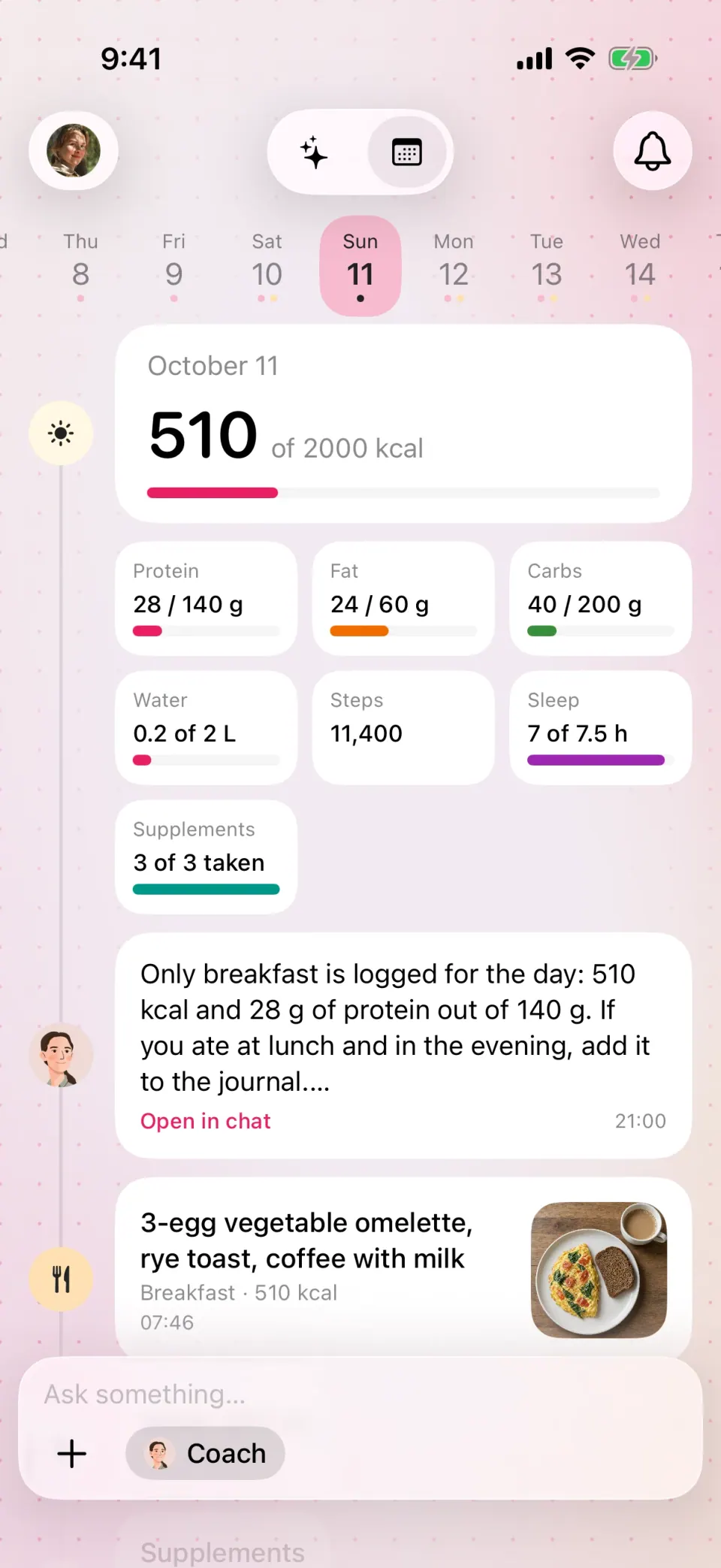
The AkMe journal for today, with the team's morning note at the top: today's plan and a line about last night.
A small house on a hill above the sea at sunrise, mist lying between the hills.

Start at home

A gym is a whole project: find one, get there, new people, a coach, a program — and feeling awkward about where you are right now. At home, none of that.

  • No one is watching.
  • A program built around your time and what you have at home: the Methodologist asks how many minutes you've got and what equipment, and picks exercises to match. It will tell you honestly what's missing.
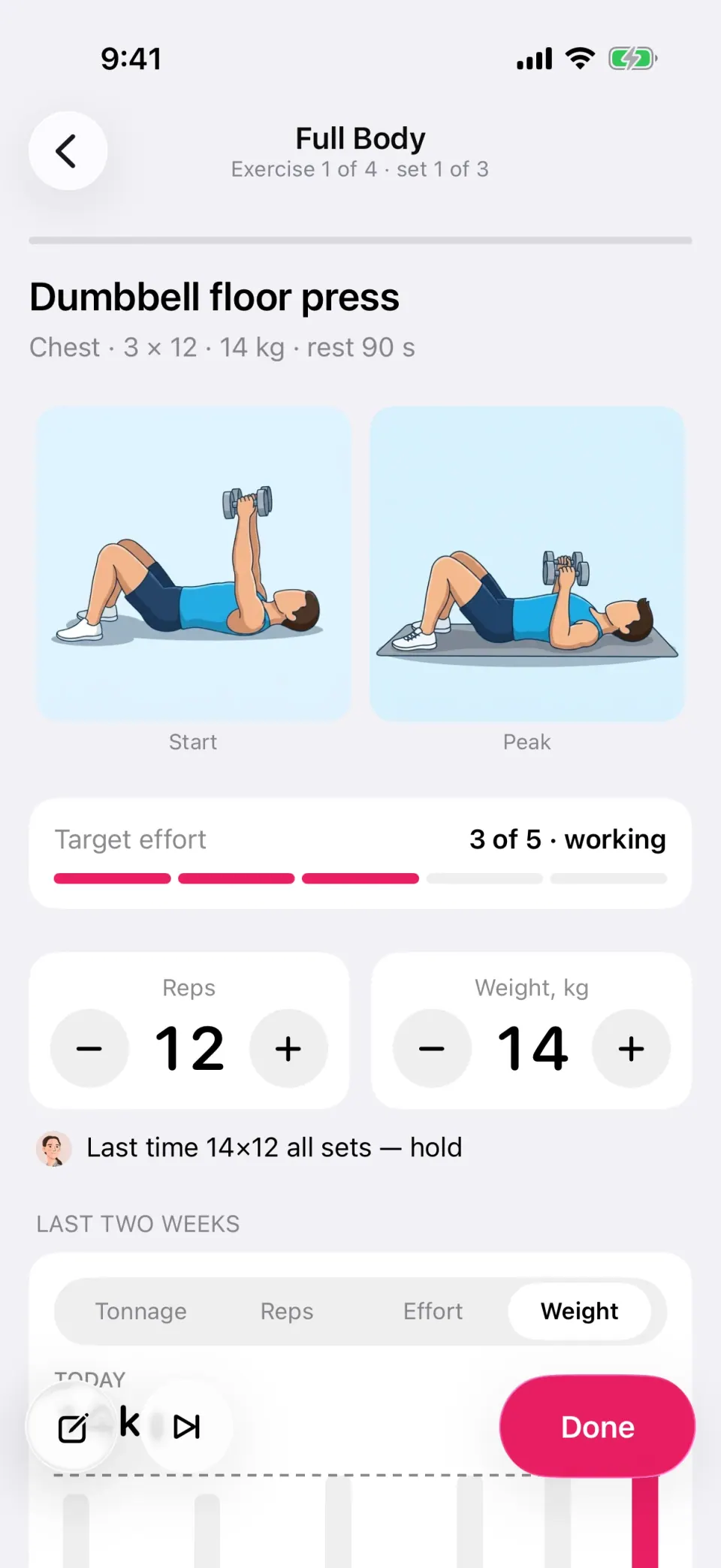
  • Workouts are guided step by step: sets, weights, an illustration and how to do each exercise, rest between sets.
  • A 3–5 minute warm-up before strength work. And if you feel stiff and want to change that — 5–10 minutes of stretching afterwards, 2–3 times a week. Risky poses are flagged, and for unsafe ones your team suggests an alternative.
  • The catalog has about 600 illustrated exercises — for home and for the gym.
  • You start to feel your muscles and see progress.
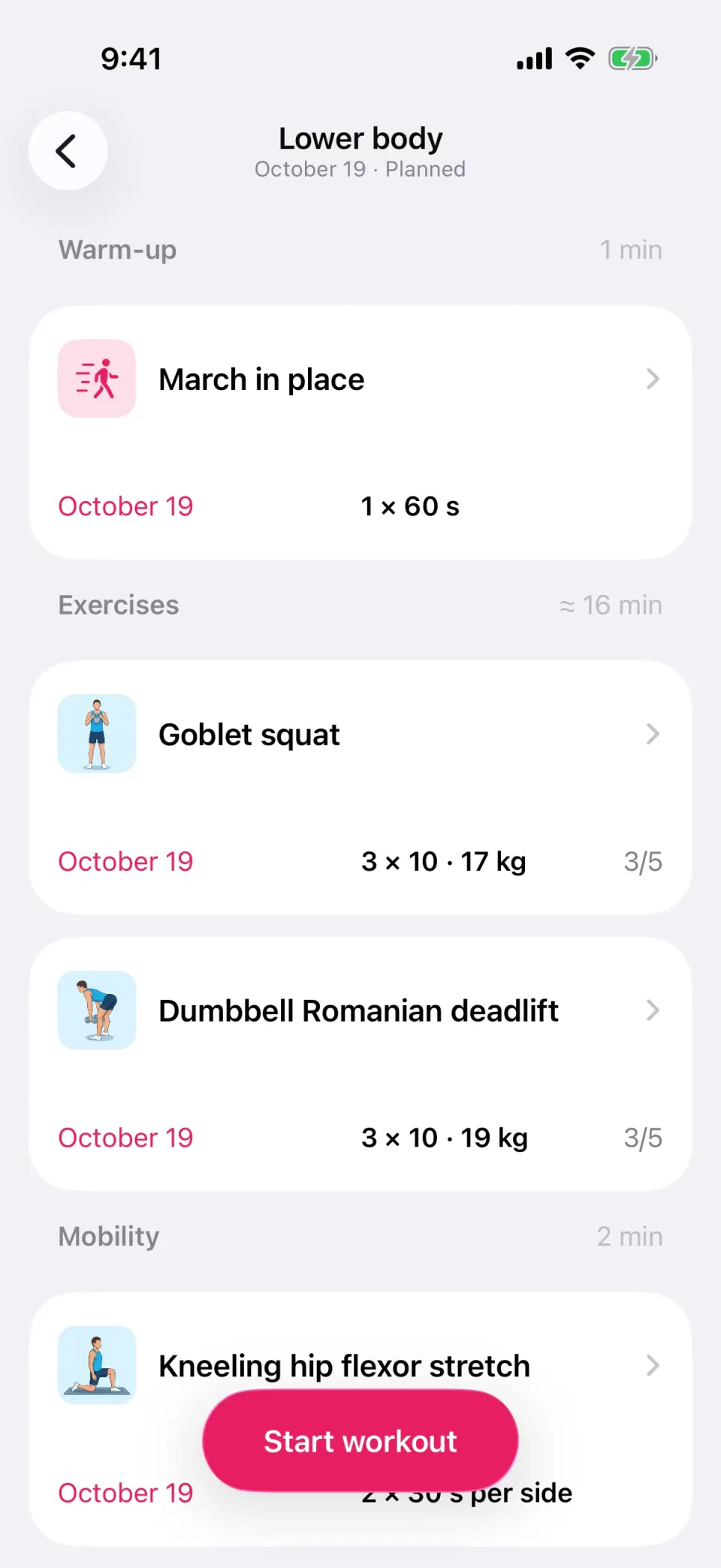
A lower-body workout overview in sections — warm-up, exercises and mobility — with the time for each.
A dumbbell workout in progress: the exercise illustration, sets, weight and a rest timer.

Your team

AI specialists, not people. You talk to the Coach, and it brings in the others when needed.

  • Methodologist

    Gets to know you and builds a program weeks ahead: phases, dated goals, daily targets. Once a week checks it's working and explains what changes.

  • Coach

    With you every day: training, food, sleep, measurements, answers to your questions.

  • Chef

    Turns your targets into food: recipes from what’s in your kitchen, a week’s menu, a shopping list, what to order when you eat out.

  • Journal

    Logs meals from a photo or a line, workouts, measurements, water and supplements. You barely notice it.

  • Photo reader

    Understands what's in a photo: a meal, a label, a document.

  • Shopping

    Finds prices, availability and nutrition facts in stores near you.

  • Tech support

    Something wrong in the app, or an idea? Tech support writes it up for our team, sends it once you say yes, and tells you when it’s done.

What a normal day looks like

  1. Morning

    Morning note.

    Today's plan and a line about your night, if you wear a watch or ring. Nothing you could read off the screen yourself.

    A glass of water on a windowsill at dawn, the sea and the rising sun beyond.
  2. Midday

    Lunch photo.

    Snap your plate — the dish, calories and protein are logged, and the home screen shows what's left for the day.

    A simple lunch on a terrace table — fish, greens and tomatoes — with misty hills and the sea beyond.
  3. After a workout

    Review.

    Mark your workout done in the app and your team reviews how it went compared with last time and sets the next weight for every exercise. If something hurt, it deals with that first.

    A pair of dumbbells and a folded towel on a sunlit floor by an open door to the hills.
  4. Evening

    End-of-day check.

    Short on protein? Your team suggests a dinner. On track? You won't hear a thing.

    A bowl of salad and a warm lamp on a table by a window looking out on the hills.
  5. Sunday

    Program check.

    The Methodologist decides to keep going or adjust — and says why.

    A cup of coffee and a closed notebook on a terrace table, misty hills behind.

Your team writes in the app and sends a notification to your phone.

Habits, not sprints

Deadline goals — waist, weight, body fat. Daily goals — protein, water, calories. Your team keeps you on track without pressure: it suggests revising a goal that isn't working, and always tells you the good news.

  • It spots what daily numbers hide — like your waist shrinking while the scale stands still.
  • When there's nothing to say, it stays quiet. No daily "all good" messages.
  • Measurements on schedule: it reminds you and calculates body fat and waist-to-height ratio. Progress photos side by side with your last ones, with a pose guide.
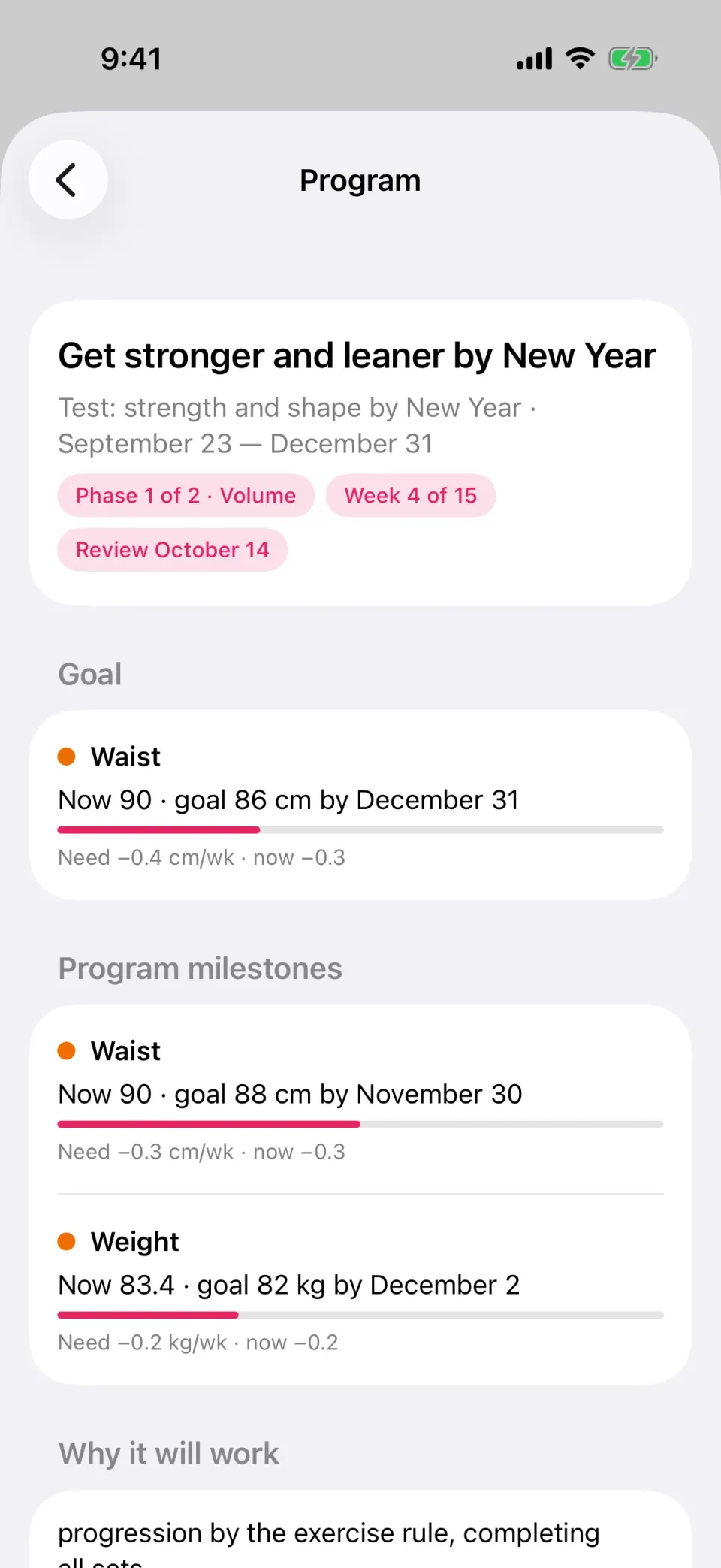
The program screen: the current phase, dated goals and daily targets.
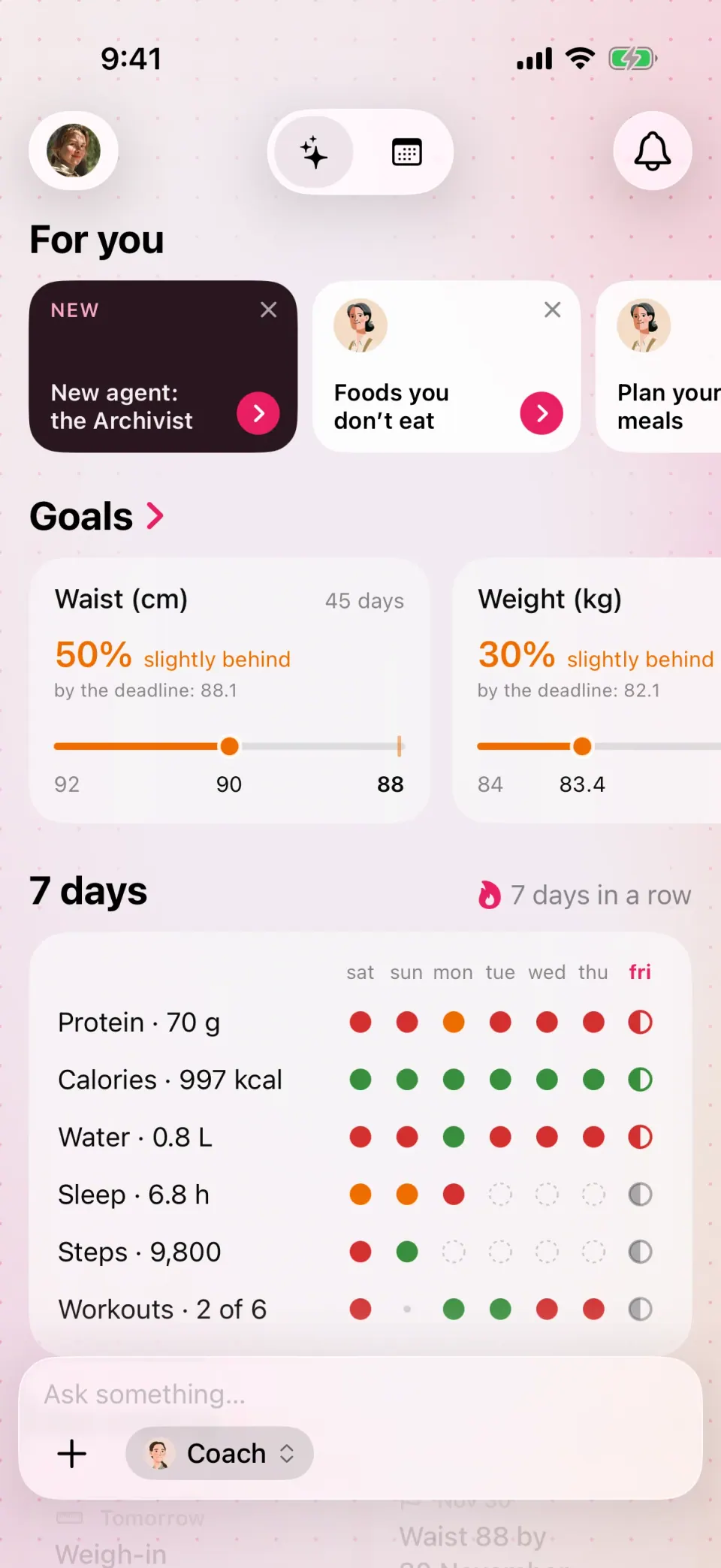
The home screen: today's calories, protein and water against your targets, and progress towards your goals.

Food without counting

A photo or one line — "oatmeal with banana and two eggs" — and the dish, calories, protein, fat and carbs are in your journal. It's an estimate, not a lab test. Your day is measured against your own targets, not averages.

  • What to cook with what’s at home? Ask the Chef. It suggests a recipe for what you still need today and adapts it: without an ingredient, for more or fewer servings.
  • Dinner out and a glass of wine aren't a failure. The Chef helps you choose and fit it into the day, no lectures.
  • Batch cooking: a week’s menu, how long dishes keep, and a shopping list in the language of your country — Shopping finds the products nearby.
  • An allergy, a doctor's rule or a vegetarian diet — the Chef won't suggest what you can't have, and notices when it's hidden in a sauce or a pastry.
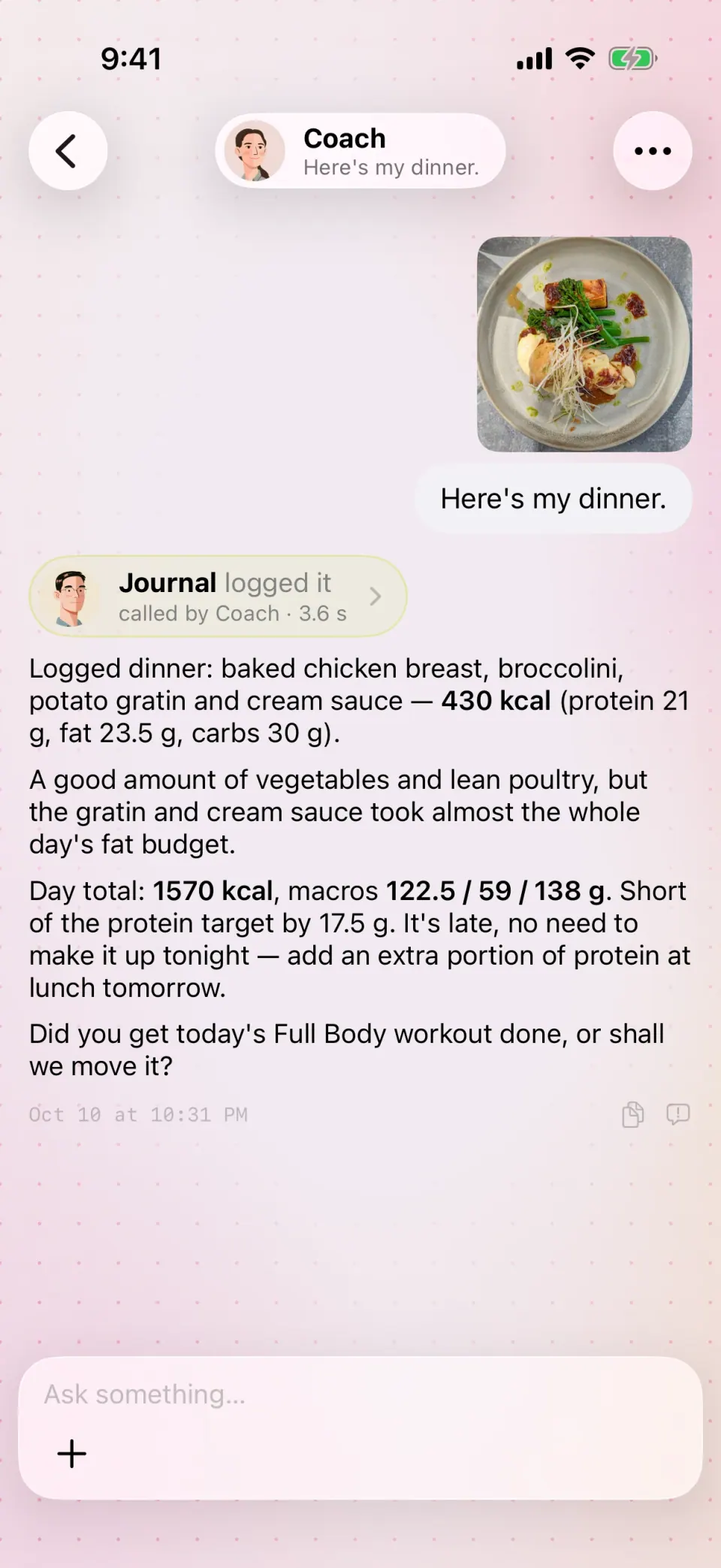
A chat with the team: a photo of a lunch plate, and the logged dish with calories, protein, fat and carbs.

Your night, explained by your day

Sleep stages, overnight heart rate and your sleep debt over two weeks — from your Apple Watch, a ring that writes to Apple Health, or just your iPhone. Your Coach starts with the why — a late dinner, a glass of wine, a hard session — and what to do today. The charts come after.

Stages and heart rate are your device's estimates, and the Coach says so.

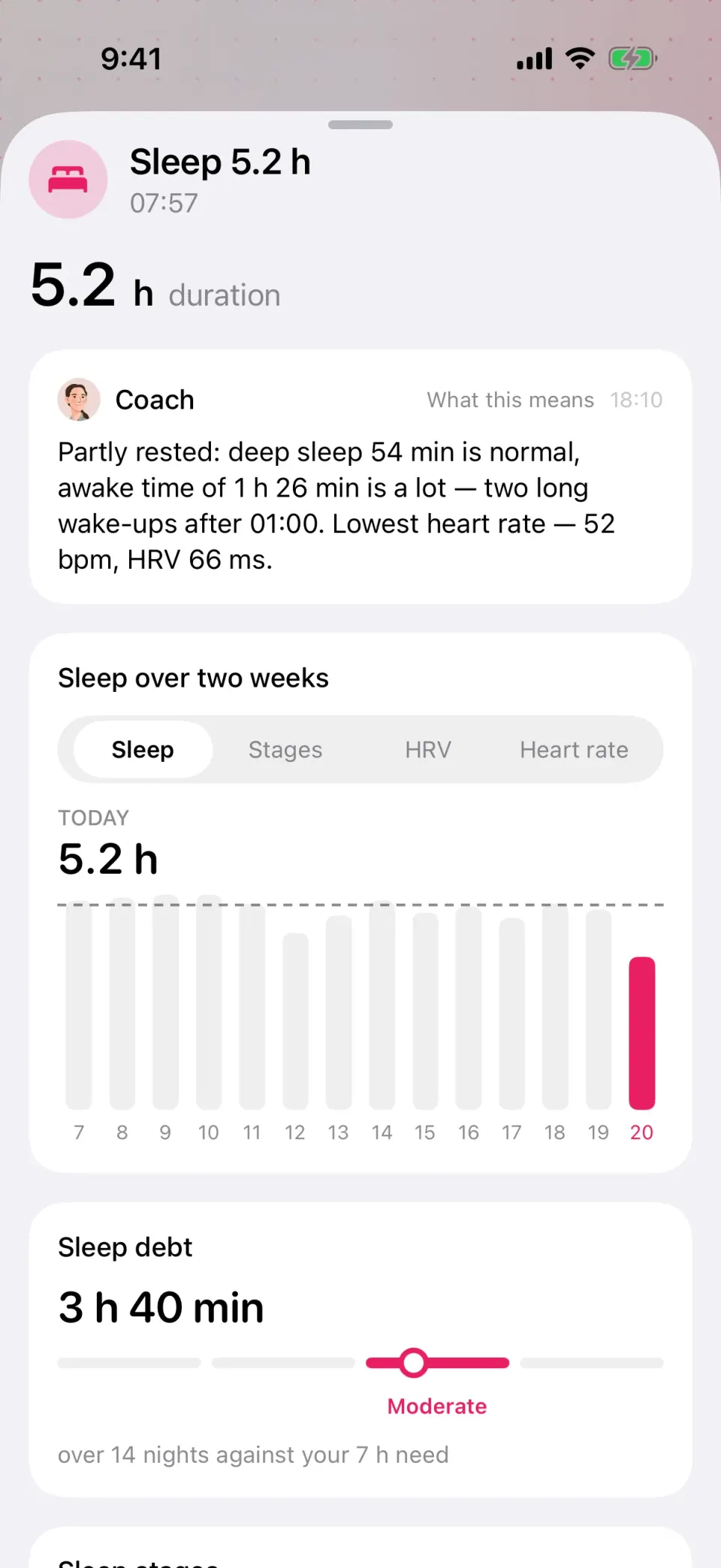
The night card: the Coach's take on last night at the top, sleep stages and overnight heart rate below.

Runs, rides and swims from your watch

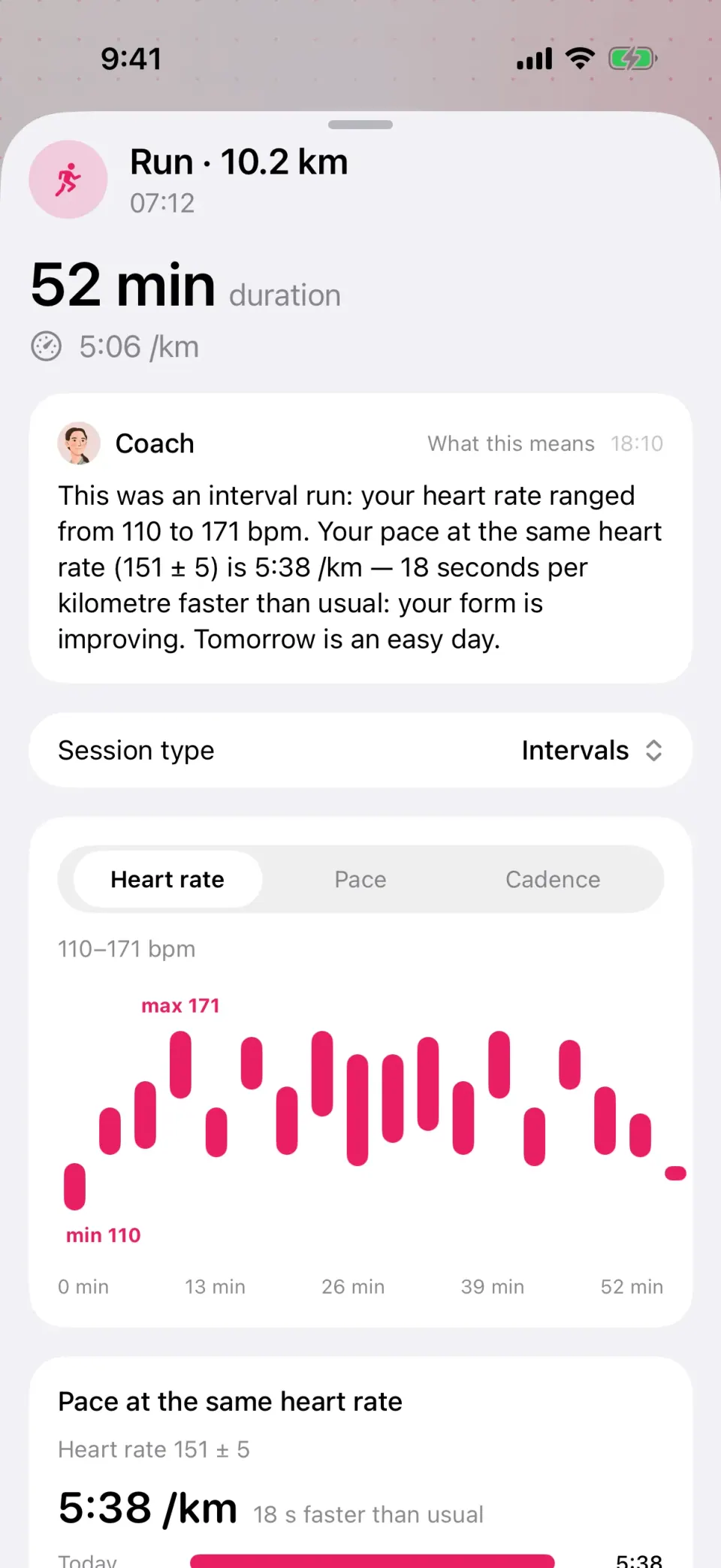
Any watch or ring that writes to Apple Health on your iPhone will do. Your Coach reviews every session: what kind it was (intervals, tempo, long or easy — you can correct it) and your pace against your usual pace at the same heart rate. Your program is built around what you already do, not a template.

Already train seriously? The team doesn't teach you — it keeps an eye on your numbers.

A run from the watch: the Coach's review with the session type, plus heart rate, pace and cadence charts.

Your team remembers you — and shows you what it knows

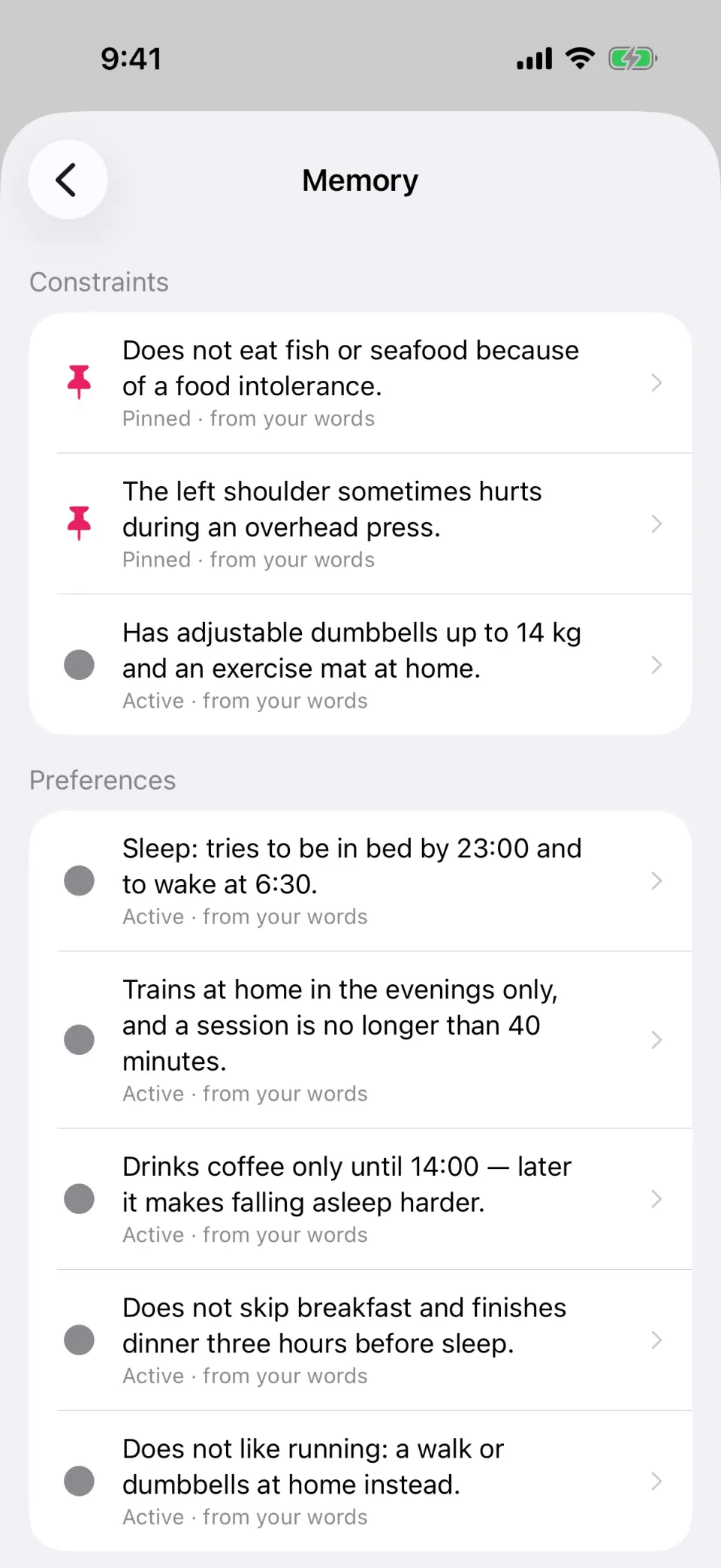
Injuries, limits, equipment, your routine, what you agreed on last week. You don't have to repeat yourself. Everything your team remembers is visible in the app — edit it, pin it or delete it.

  • It answers questions about food, training and routine using your data: whether to take creatine, what to order out, why your weight has stalled. It doesn't just agree — if an idea clashes with your goal or your safety, it says so.
The Memory screen: what the team remembers about you, from injuries and equipment to agreements, each item editable.

Everything that matters about you, in one place

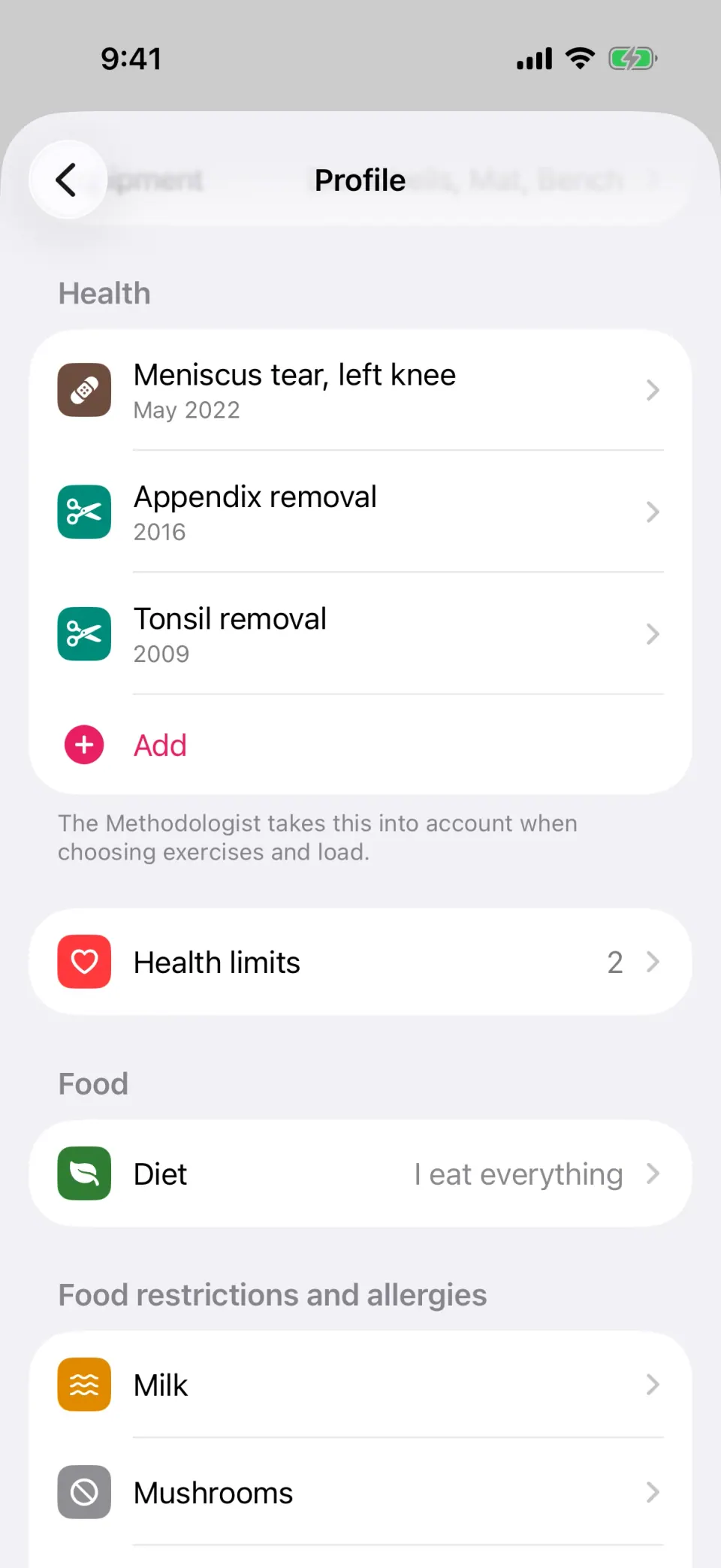
Surgeries and injuries, foods you avoid, how you eat, where and with what you train — it all lives in your profile. Some of it you add yourself, some your team picks up from conversation. And every specialist takes it into account.

  • Surgeries and injuries. What happened and when. The Methodologist builds it into your program and picks exercises that don't load what was injured.
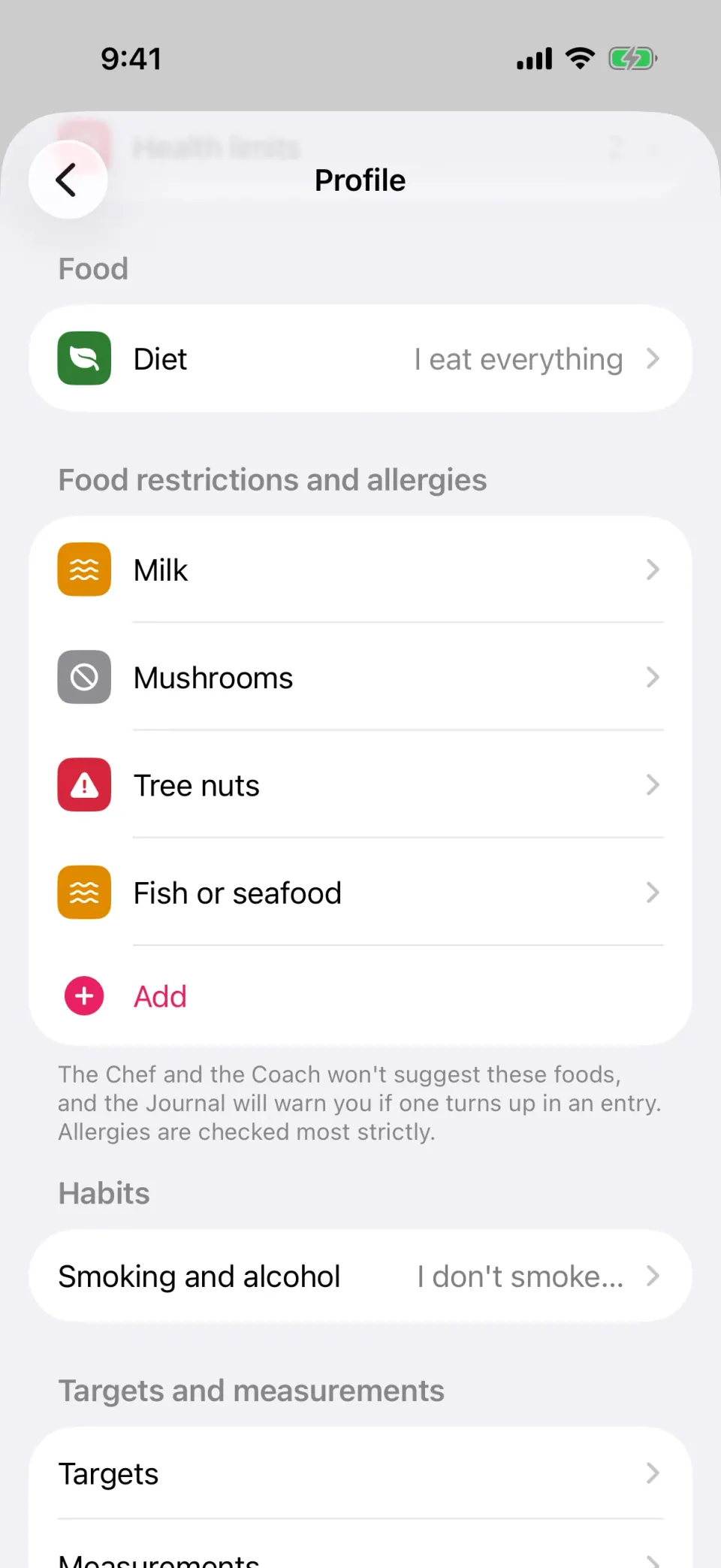
  • Allergies and food restrictions. An allergy, a doctor's rule, an intolerance or just "I don't eat that". The Chef and the Coach won't suggest those foods, and allergies are checked most strictly.
  • How you eat. Vegetarian, vegan, halal, kosher and more — recipes and menus follow it.
  • Smoking and alcohol. Noted without judgement. Your team factors it into your plan, and sets a limit only if you decide to cut back.

It's all visible in the app — edit it or remove it any time.

The Health section of the profile: surgeries and injuries with their dates, and an Add button.
The Food restrictions and allergies section of the profile: an allergy, foods you don't eat and your chosen way of eating.

No menus to dig through — just say it

Goals, your program, foods to avoid, journal entries — almost everything changes in conversation. Say it in your own words; the right specialist does it and tells you what changed.

  • "I want to lose 5 cm off my waist by summer"

    Methodologist

    the Methodologist updates your goals and targets and explains why.

  • "No more sugar for me"

    Methodologist

    the Methodologist adds the rule, and the Chef won't suggest recipes with sugar.

  • "Delete yesterday's snack"

    Journal

    the Journal removes it and your day's totals update.

  • "My morning notification didn't arrive"

    Tech support

    Tech support writes it up and tells you when it's fixed.

Everything that changes is visible in the app — your program, goals, memory and journal. Sign-in, notifications, connections, language and theme live in Settings.

What the advice is based on

Your team relies on the findings of scientific research, not on fads: reviews of dozens of studies, clinical trials, and guidelines from the WHO and professional bodies. Every finding is checked against the paper itself, and each one links to it. There are more than 1,500 in the library today — on protein, sleep, strength training, mobility and stretching, memory and thinking, alcohol, supplements and popular myths — and it keeps growing.

  • Sources under the answer. When your team explains a decision — why this much protein, why strength training — the sources appear below the answer. Tap to see the finding itself, who it applies to, and a link to the paper.
  • An honest verdict. Every finding carries one of four labels: "Works", "Doesn't work", "Mixed evidence" or "Harmful". Plus a caveat on where the research has its limits.
  • No made-up citations. If there's no finding on your question, the team answers from general knowledge — and never passes it off as research. If the evidence is mixed, it says so.
  • No lectures. Sources show up only when your team explains a decision or you ask why. The rest of the time, it's just advice.

Research findings describe people on average; your doctor knows more about you. AkMe doesn't diagnose or treat.

What research says about advice you've probably heard

Doesn't work

Network meta-analysis · 22 trials, 647 participants

Frequent meals gave no advantage: 2 meals a day reduced weight more than 6 (MD −1.29 kg; 95% CI −1.74 to −0.84).

Evidence is limited; the certainty ranges from moderate to very low.

Schwingshackl et al., 2020 · Adv Nutr ↗

Doesn't work

Meta-analysis · randomised trials

A smaller dinner did not produce more weight loss than a larger dinner (difference −0.89 kg; 95% CI −2.52 to 0.75).

Meta-analysis; between-study heterogeneity can be large.

Fong et al., 2017 · Br J Nutr ↗

Doesn't work

Systematic review · for adults

Thermogenic fat burners have not shown a lasting effect on weight: the 95% confidence interval crosses zero.

Systematic review; some conclusions are not from meta-analysis.

Clark et al., 2021 · Nutr Health ↗

Harmful

Meta-analysis · for adults sleeping 5.5 h or less

Partial sleep restriction increases daily energy intake by 204 kcal on average (95% CI 112–295).

The studies were short and done under controlled conditions.

Fenton et al., 2021 · J Hum Nutr Diet ↗

Harmful

Laboratory experiment · healthy adults aged 21–38; 48 people

Chronic restriction to 6 hours of sleep a night produced cognitive deficits equivalent to up to 2 nights of total sleep deprivation.

Classic 2003 study; subjective sleepiness underestimated the real deficit.

Van Dongen et al., 2003 · Sleep ↗

Works

Meta-analysis · for adults doing strength training for 6+ weeks

With strength training, protein supplements add muscle gain, but above a total intake of 1.62 g/kg/day there is no further gain in fat-free mass.

Meta-analysis; between-study heterogeneity can be large.

Morton et al., 2018 · Br J Sports Med ↗

Mixed evidence

Meta-analysis · for healthy adults

Training to failure is only trivially better than stopping short of failure for muscle growth.

Meta-analysis; between-study heterogeneity can be large.

Refalo et al., 2023 · Sports Med ↗

Works

Meta-analysis of observational studies · for adults

Daily steps are non-linearly linked to mortality and cardiovascular events, with a bend at about 5000–7000 steps a day.

Observational data; causation is not proven.

Ding et al., 2025 · Lancet Public Health ↗

Doesn't work

Meta-analysis · athletes and physically active people; 25 randomised trials, 26,610 participants

Stretching did not reduce the risk of sports injuries (RR 0.963; CI 0.846–1.095).

Classic study (2014); no more recent reviews with these numbers.

Lauersen et al., 2014 · Br J Sports Med ↗

Works

Meta-analysis · athletes and physically active people; 25 randomised trials, 26,610 participants

Strength training reduced the risk of sports injuries (RR 0.315; CI 0.207–0.480).

Classic study (2014); no more recent reviews with these numbers.

Lauersen et al., 2014 · Br J Sports Med ↗
1 / 10

Why not a chat, a tracker or a personal trainer

Each of them helps. None of them guides you every day across everything.

—What it givesWhat's missing
AI chatChatGPT and the likeA smart answer to any questionMemory that lasts months: after 3–4 weeks the thread sprawls, details get lost and numbers go wrong. Your data — only what you paste in. Initiative: you always write first. It may cite sources, but whether the paper backs the answer, and for whom, is yours to check.
Calorie and step trackerAccurate counts and chartsSomeone to tell you what to do about it. You log and work it out yourself
Weight-loss programA course, lessons and meal plansTraining and sleep. Flexibility for your life. Usually one goal — a number on the scale by a date
Personal trainerA person beside you at the sessionFood, sleep and the days between sessions. By appointment, and expensive
Nutrition or health consultantAn expert review and recommendationsDay-to-day guidance: between meetings you're on your own
AkMeA team of AI specialists runs your training, food, sleep and habits as one system, every day, and writes first. It remembers you and sees your journal, measurements and sleep; totals come from software, not the AI. It draws on 1,500+ research findings, each checked against its paper: Works, Doesn't work, Mixed evidence or Harmful, and for whom. The source sits under the answer when the team explains why.—
  • AI chatChatGPT and the like

    What it gives
    A smart answer to any question
    What's missing
    Memory that lasts months: after 3–4 weeks the thread sprawls, details get lost and numbers go wrong. Your data — only what you paste in. Initiative: you always write first. It may cite sources, but whether the paper backs the answer, and for whom, is yours to check.
  • Calorie and step tracker

    What it gives
    Accurate counts and charts
    What's missing
    Someone to tell you what to do about it. You log and work it out yourself
  • Weight-loss program

    What it gives
    A course, lessons and meal plans
    What's missing
    Training and sleep. Flexibility for your life. Usually one goal — a number on the scale by a date
  • Personal trainer

    What it gives
    A person beside you at the session
    What's missing
    Food, sleep and the days between sessions. By appointment, and expensive
  • Nutrition or health consultant

    What it gives
    An expert review and recommendations
    What's missing
    Day-to-day guidance: between meetings you're on your own
  • AkMe

    What it gives
    A team of AI specialists runs your training, food, sleep and habits as one system, every day, and writes first. It remembers you and sees your journal, measurements and sleep; totals come from software, not the AI. It draws on 1,500+ research findings, each checked against its paper: Works, Doesn't work, Mixed evidence or Harmful, and for whom. The source sits under the answer when the team explains why.

Made for iPhone

  • Home screen: your day against your targets, goal progress and what's ahead.
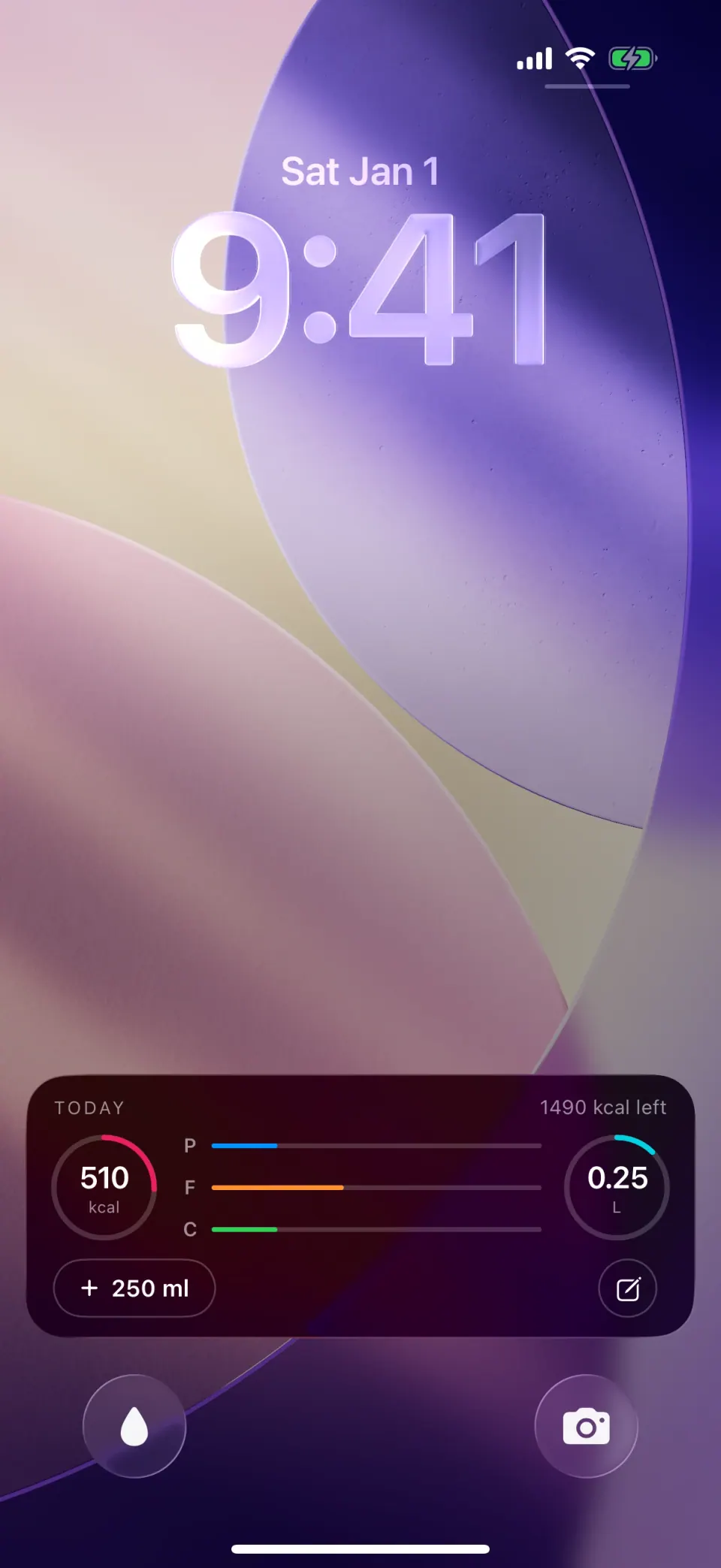
  • A glass of water or a meal photo, right from the Lock Screen and Control Center.
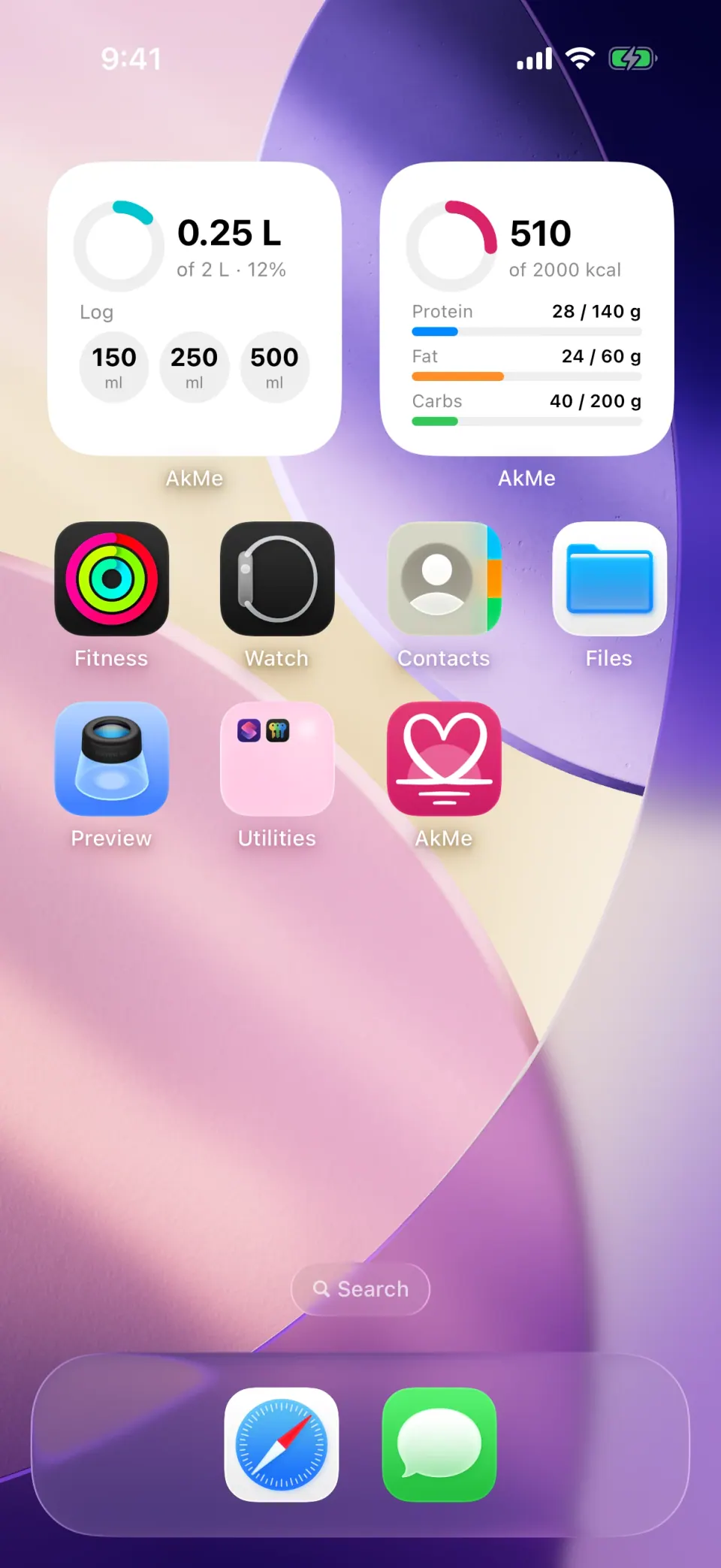
  • Widgets: water, calories and macros, supplements.
  • Today's food and water on your Lock Screen, in the Dynamic Island and in CarPlay.
  • Apple Health: sleep, heart rate, steps and workouts from your watch or ring come in on their own.
  • No signal? Entries are saved on your phone and sent automatically.
  • English. Your team replies in the language you write in.

Requires an iPhone with iOS 26. Android later.

The iPhone Lock Screen with AkMe controls for logging a glass of water or a meal photo.
AkMe widgets on the iPhone Home Screen: water, calories and macros.

Your data stays yours

  • Stored on our servers in the European Union.
  • Only your agents see them. Every person has a separate space.
  • To answer you, an agent sends the AI model only what that answer needs: your first name, what your team remembers about you, the current conversation, the journal entries it looked up, and any photos you sent. The model never gets your surname, email, password or account number.
  • We use the model through corporate (business) access. The provider has no account for you and keeps no profile or memory about you — everything your team remembers is stored with us. Under its terms, these requests aren't used to train models; to check for abuse, it keeps them for a limited time, typically up to 55 days.
  • When you chat with ChatGPT, Gemini or Claude directly, the conversation is tied to your account with them, they remember you between chats, and depending on your account settings your chats may be used to train their models.
  • No ads. We never sell your data.
  • Ask for a copy or deletion of your data at hello@a4ai.dev — we reply within one month.
A wide evening view of misty hills rolling down to a calm sea under a fading pink sky.

How to join the beta

  1. Apply.

    Two minutes: name, email, whether you have an iPhone and a watch or ring.

  2. Get your invite.

    We let people in in small groups so we can look after each one properly. You'll get an email with your login and a TestFlight link.

  3. Install and sign in.

    TestFlight is Apple's official app for beta versions.

  4. Meet your team.

    Answer a few questions from your team — the Methodologist will start the conversation. A short chat, and you'll have a program the same day.

Already in the beta

13 of 20

7 spots left

The beta lasts 14 days and is free. We'd be very grateful for your honest feedback.

FAQ

What does AkMe mean?

Akme (ἀκμή) is Greek for prime — the peak of one's powers. Ancient writers placed a person's akme at around forty. And the "Me" in the name is you: the team works with you, and you build yourself.

Why not just use ChatGPT?

In a chat everything lives in the thread: after 3–4 weeks it sprawls, details get lost and numbers go wrong. In AkMe every entry — a meal, a workout, a measurement, a night — is stored in a database. Daily totals, trends, goal progress and body fat are calculated by software, not by the AI, so the numbers don't drift over time; your team reads the finished numbers and explains them. And it writes first instead of waiting for you to ask.

Where do the team's numbers come from?

There are two kinds. Your own numbers — calories, protein, weight, trends — are calculated by software from your entries, not by the AI, so they don't drift. Recommendations — how much protein, how much sleep, whether to do strength training — come from a library of research findings: reviews of studies, clinical trials, and guidelines from the WHO and professional bodies. Every finding is checked against its paper, and you can open the source right under the answer. When the evidence is thin or conflicting, your team says so.

Does it replace a doctor?

No. AkMe is a training, nutrition and routine aid, not a medical device. It does not diagnose or treat anything. If you have a medical condition or injury, or are pregnant, talk to your doctor before changing your diet or training.

Are there real people?

No. AI specialists work with you. There's no human in the conversation.

I'm over 50. Is it too late?

No. Your team builds the program from where you are: your experience, limits and time. Timelines are realistic, and the load grows gradually.

I already go to a gym. Is it for me?

Yes. The exercise catalog includes barbell, kettlebell, cable and machine exercises. Tell the Methodologist where you train and it will plan around your place and equipment.

Do I need a watch or ring?

No. Everything works without one, and your iPhone alone gives the team your time in bed. A watch or ring that writes to Apple Health adds sleep stages, overnight heart rate and your runs, rides and swims.

I have an injury. Is it for me?

Yes. Add your surgeries and injuries to your profile — what happened and when — and the Methodologist picks exercises and load around them. If something hurts now, your team deals with that first and tells you to see a doctor if it's serious. We don't do rehabilitation.

I have a food allergy. Will it be taken into account?

Yes. Mark it in your profile — the list covers the 14 major allergens, and you can add any other food. The Chef and the Coach won't suggest it, and the Journal warns you if it turns up in an entry. It's a help, not a guarantee: with a severe allergy, always check ingredients yourself.

I don't eat meat. Is it for me?

Yes. Choose how you eat — vegetarian, pescatarian, vegan, halal, kosher or your own way — and recipes and menus will follow it.

I smoke or drink. Is that a problem?

No. Just say so — your team factors it into your plan, no lectures. If you want to cut back, it'll help you set your own limit — but only if you ask.

What do I need?

An iPhone with iOS 26. Android later.

How much is it?

Free during the beta. After the App Store launch it will be a subscription.

Which languages?

English. Your team replies in the language you write in.

Who sees my data?

Only your agents. Data is stored in the EU, there are no ads and we never sell data. Details are in the privacy policy.

How do I delete my data?

Email hello@a4ai.dev from your account address — we'll delete it and reply within one month.

Why so few spots?

We set up every account by hand and watch how the product works for each new person, so we let people in in small groups.